DWGAL-08
Two-Drone Racing Testbed
Research in Dr. Sarah Li's C3U Lab at Georgia Tech. Two Crazyflie quadrotors race in a Vicon arena to test whether Nash and Stackelberg strategies keep their predicted advantage on real hardware.
Role
Undergraduate researcher
When
October 2026 to present
Where
C3U Lab, Georgia Tech
Tools
Crazyflie 2.1 BrushlessViconCrazyswarmROS 2TypeScriptPythonControl barrier functions
Status
Simulator built, flight testbed in progress
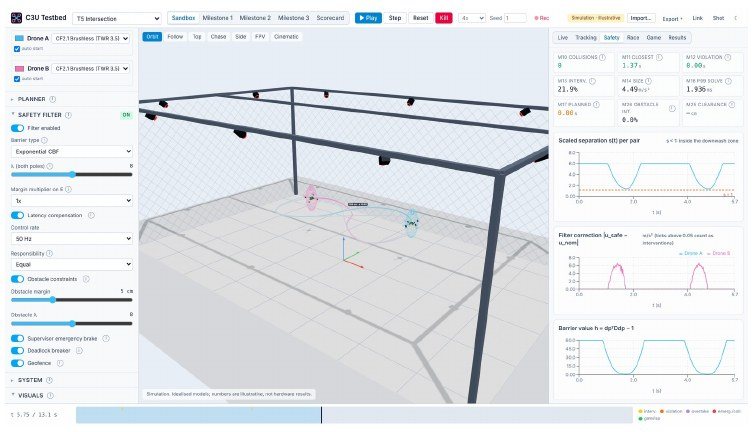
Live simulator: c3u-lab-testbed-demo.vercel.app
The question
Game-theoretic planners predict that one racing drone can gain an advantage over another by planning around what the other will do. Those predictions assume perfect tracking and no delay. Real drones have both. The testbed measures how much of the predicted advantage survives.
TRY ITTwo drones on a figure-8. Turn the safety filter off and see what happens.
What I built
- A 3D simulator of the whole testbed, with the real logic in a unit-tested TypeScript core that is written to port to Python and ROS 2.
- A trajectory validator and executor, and a supervisor that can stop a run.
- A control barrier function safety filter that keeps each drone out of the other's downwash, acting only when it has to.
- Automatic scoring. A crash always scores zero.
- A sandbox to sweep scenarios, speeds, latencies and filter settings before anything flies.
92Unit tests
27Performance metrics
3.1 m/sFigure-8 tracking speed
20 msControl step
30Races per condition
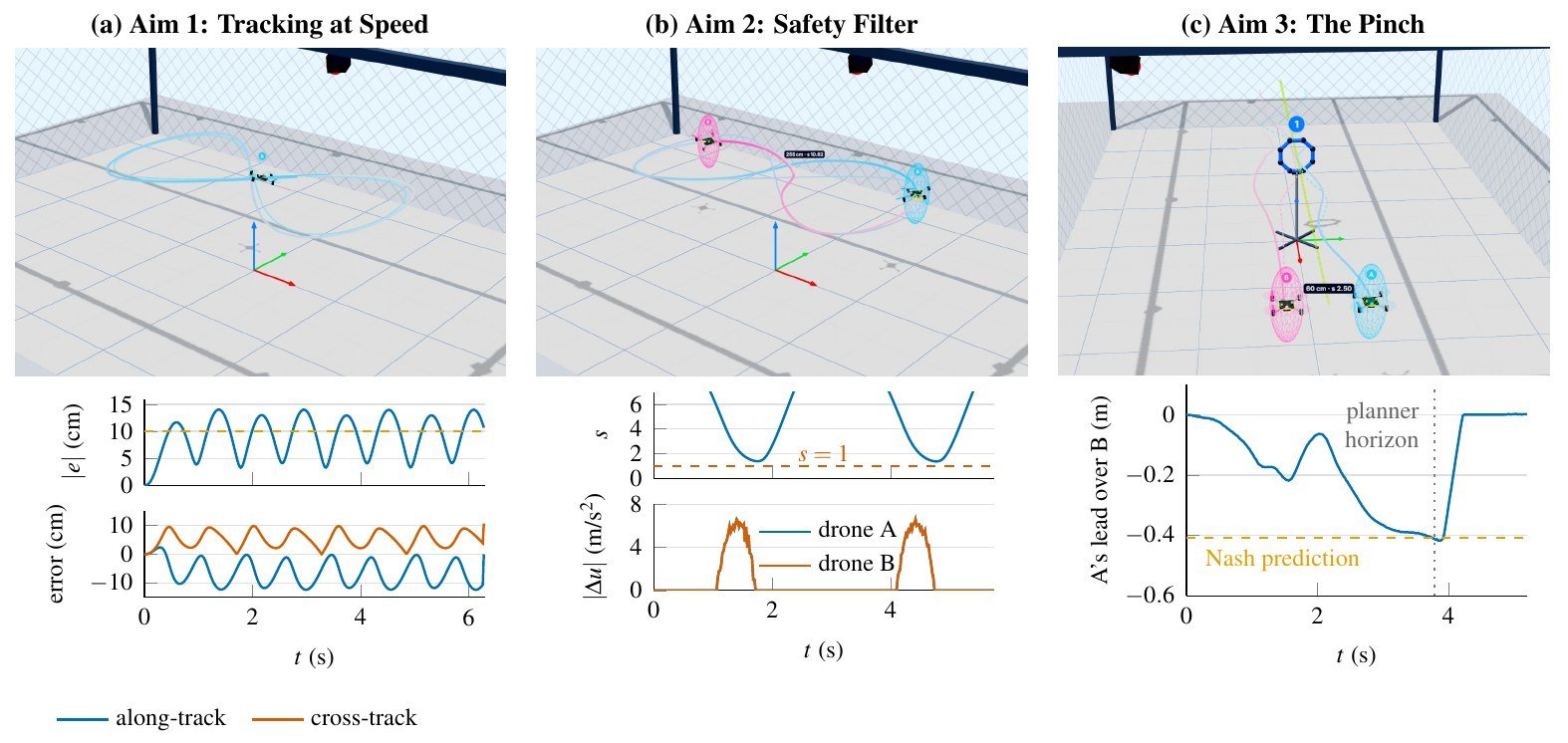
Now
I'm building the flight testbed: Crazyflie 2.1 Brushless quadrotors in a 10-camera Vicon arena, running on Crazyswarm and ROS 2. First hover, straight line and square with one drone, then two.